
Reviewed · SANTA TERESA & LAPA
Walking tour of the bohemian neighborhoods of Santa Teresa and Lapa
Rio’s art starts on a hill.
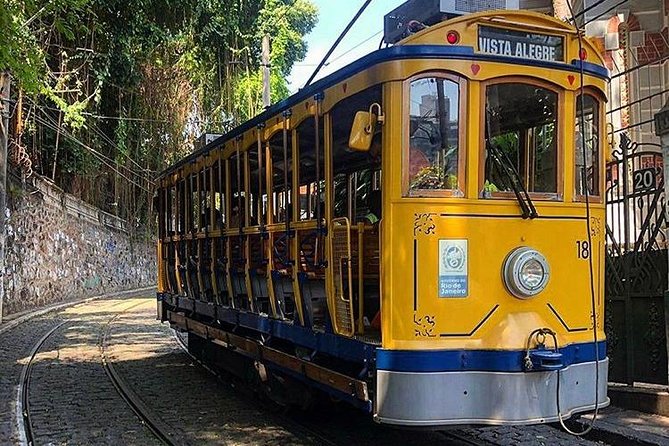
This 3.5-hour Santa Teresa to Lapa walking tour strings together iconic views, colorful street art, and a yellow Bonde tram ride up the slopes.
I love the mix of neighborhoods in one route, so you don’t waste time hopping around Rio. I also love that the stops include both big landmarks and small streets where you can see how the city actually lives.
One heads-up: the area is hilly and there are lots of steps, so if you’re fragile on your feet, plan to move at an easier pace and wear solid shoes.
In This Review
- Quick hits before you go
- Why Santa Teresa to Lapa works so well in one morning
- Getting started from Copacabana and riding the yellow Bonde
- Largo dos Guimarães: old houses and the best kind of wandering
- Parque das Ruínas viewpoint: Laurinda Santos Lobo’s legacy
- Selarón Steps: the staircase that took about twenty years
- Arcos da Lapa aqueduct: street art meets old infrastructure
- Cinelândia square: Teatro Municipal and a still-working Odeon
- Guide quality is the whole experience: Edmundo, Lorena, and Ivan
- Timing, walking pace, and what to wear on a hill day
- Price value at $72.09: what you’re actually paying for
- Who should book this (and who might want to rethink it)
- Should you book this Santa Teresa and Lapa walking tour?
- FAQ
- FAQ
- What time does the tour start, and how long is it?
- How much does it cost, and what’s included?
- Where is the meeting point, and does it end there too?
- How big is the group?
- Is the tour refundable or changeable?
- Is this walking tour suitable for most people?
Quick hits before you go
- Yellow Bonde tram ride up Santa Teresa for panoramic views
- Largo dos Guimarães for old houses, good viewpoints, and local hangouts
- Parque das Ruínas (former home turned viewpoint) with views toward Christ and Botafogo
- Escadaria Selarón multicolored staircase tied to George Selarón’s decades-long work
- Arcos da Lapa aqueduct area with graffiti-covered walls and the tram passing through
- Cinelândia square highlights, including the Teatro Municipal and the still-operating Teatro Odeon
More of bohemian Santa Teresa and Lapa
- Rio: Christ the Redeemer, Sugarloaf, Selaron & BBQ Lunch★ 4.5 · 2,428 reviews
- Rio: Pub Crawl in Lapa with Cachaça Tasting and Live Samba★ 4.7 · 881 reviews
- Rio de Janeiro: Christ, Selaron Steps, and Tijuca Park Tour★ 4.7 · 857 reviews
- Santa Teresa, Lapa, and Cinelândia with Tram Ride and Selarón Steps★ 4.5 · 274 reviews
Why Santa Teresa to Lapa works so well in one morning
Santa Teresa feels like Rio’s arty cousin: winding streets, viewpoints, and a “stroll and look” rhythm. Lapa, on the other hand, is where the city gets louder—street art, nightlife energy, and those famous arches.
This tour stitches them together without trying to cram every single sight in town. You get the hill-town charm first, then you descend into the more urban, graphic world of Lapa. The pacing also makes sense: a tram up, a walk down, and breaks for the best viewpoints.
And with a maximum of 12 travelers, you’re not lost in a crowd. It’s the kind of group size where your guide can actually answer questions and adjust if something gets slow on the street.
Getting started from Copacabana and riding the yellow Bonde
The tour meets at Copacabana Palace, A Belmond Hotel on Av. Atlântica (start time 9:00am). From there, you’ll get to the Santa Teresa Tram station and hop on the famous yellow Bonde.
Stop 1 is the tram ride up toward Santa Teresa, described as a panoramic stretch of about thirty minutes. This is a smart opener. It gets you oriented fast—those steep grades are a big part of Santa Teresa’s personality—and it drops you into the neighborhood with the right mood already set.
Practical note: a tram ride is comfortable, but once you’re up, you’ll still be walking on uneven streets. Bring shoes that can handle cobbles and slopes without slipping.
Largo dos Guimarães: old houses and the best kind of wandering
From the tram ride, you move into Largo dos Guimarães, right in the heart of Santa Teresa. This is where the tour slows down in the best way. Instead of racing from landmark to landmark, you circle the square and nearby lanes to spot buildings from the late 1800s into the early 1900s.
I like this stop because it’s not just “look at the view.” You also get a feel for the neighborhood’s fabric—restaurants, bars, and the steady flow of people using the space like a living room.
The views matter too. Santa Teresa gives you Rio from angles that don’t show up from the flat beaches. You’ll see how the city’s parts layer on top of each other: hills, downtown sprawl, and the sense that you’re looking down from a creative perch.
Still browsing Rio de Janeiro? These are the ones we go back to





Parque das Ruínas viewpoint: Laurinda Santos Lobo’s legacy
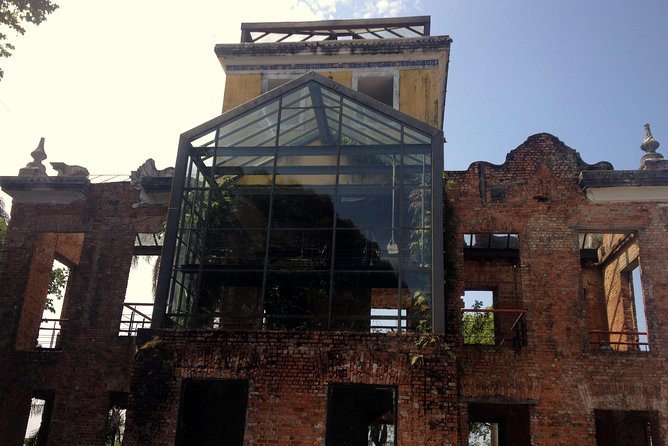
Next up is Centro Cultural Municipal Parque das Ruínas, a signature Santa Teresa stop. It’s the former home of Laurinda Santos Lobo, later transformed into a gazebo-like viewpoint.
What you’re really buying here is perspective. From this point you can see multiple Rio icons in one sweep: the Centro area, the arches of Lapa, Christ, and Botafogo. It’s one of those “now I get the geography” moments that makes the rest of your sightseeing click.
This stop is also free to visit during the tour. So it’s great value: you spend your time looking at the city instead of spending it in lines or paying entry fees you don’t need.
Selarón Steps: the staircase that took about twenty years
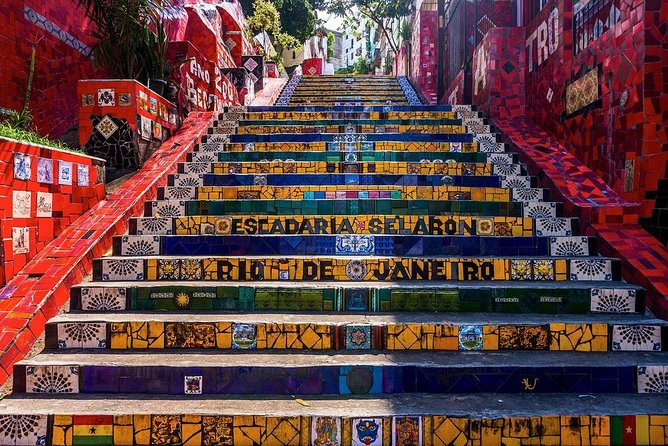
Then you head from Santa Teresa toward Lapa at the foot of the hill, passing by the famous Escadaria Selaron. This is the multicolored staircase created by Chilean artist George Selarón, built over roughly twenty years.
I love this kind of public art because it doesn’t feel like a museum object sealed behind rules. It’s part of the street scene—people interact with it, photograph it, and use it as a reference point while moving between neighborhoods.
The tour keeps this stop timed so you can take in both the details and the overall vibe. You get to notice the tile colors and textures, but you also get the big idea: this is one person’s long project that became a city landmark.
Arcos da Lapa aqueduct: street art meets old infrastructure
After the steps, the walk continues to Arcos da Lapa. This is an old Rio aqueduct dating from the 1700s that supplied water to the city until the late 1800s.
Today, it’s decorative and loud—multiple graffiti layers the walls, turning the aqueduct into an outdoor gallery that keeps changing. It’s one of the best contrasts in Rio: infrastructure from centuries ago, dressed in modern street art.
Here’s a small detail I think you’ll appreciate: the tram passes through the aqueduct to access Santa Teresa. Even if you only catch it in motion briefly, that connection ties the whole route together—the hill neighborhood and the aqueduct-era spine of the city.
This stop is free. So you’re paying for time and guidance, not entry cost.
Cinelândia square: Teatro Municipal and a still-working Odeon
Next comes Cinelândia, a major square where classic Rio institutions sit close together. The tour is short here, but it’s timed to help you recognize what you’re looking at.
Key landmarks you’ll see include:
- Teatro Municipal (Rio’s opera house)
- Museu das Bellas Artes
- Câmara Municipal
- Biblioteca Nacional
- Teatro Odeon, noted as the only cinema in the square still in operation
I like Cinelândia because it balances the previous stops. Santa Teresa and Lapa lean creative and street-level. Cinelândia is more formal architecture, with the city’s cultural power visible in stone and facades.
Even if you don’t go inside, the walk-and-look approach works well. You’ll leave with names you can later connect to your own Rio plans: opera, museums, libraries, and the working cinema that still keeps the square alive.
Guide quality is the whole experience: Edmundo, Lorena, and Ivan
This tour’s standout factor isn’t only the sights. It’s the human filter that makes the places feel welcoming and understandable. In particular, multiple guides have earned top praise, especially Edmundo, Lorena, and Ivan.
- Edmundo is described as an artist himself and someone who seems to know people everywhere in Santa Teresa. That matters because Santa Teresa is full of small streets and local culture; when your guide has connections, the neighborhood feels less like scenery and more like a community you’re passing through respectfully.
- Lorena is praised for candor and humor, plus her ability to adjust quickly if timing gets messy (like issues with getting the tram going early). That flexibility is a big deal in Rio, where streets don’t always behave like a timetable.
- Ivan is highlighted as a local of Santa Teresa, and his approach is described as friendly and personable, with guidance that makes the route feel like a walk with someone who truly belongs there.
If you care about context—why a viewpoint is framed the way it is, why a staircase became a symbol, why the aqueduct exists in the middle of street art—this is where the value shows. A good guide turns photos into understanding.
Timing, walking pace, and what to wear on a hill day
This is listed at about 3 hours 30 minutes. That’s enough time to move at a normal walking pace, pause for photos, and still get explanations at most stops.
Still, plan for effort. Santa Teresa is famous for its grades, and the route includes a tram up followed by walking down, plus time at Escadaria Selarón (stairs) and along the hill-to-hill transitions.
My practical advice:
- Wear shoes you trust on sloped, possibly uneven surfaces.
- Bring sunscreen and something light for shade.
- Keep your phone accessible for quick shots, but don’t treat every corner like a sprint.
For best results, arrive ready to look slowly. That’s how you pick up the details: house styles around Largo dos Guimarães, the tile patterns at Selarón, and the layered graffiti on the aqueduct walls.
Price value at $72.09: what you’re actually paying for
At $72.09 per person, this tour can be a strong value if you like structured walking with a local guide.
Here’s the reason: the main paid element called out is the Santa Teresa tram ticket at the start. The other major sights are free to enter during the tour stops, including Parque das Ruínas, Escadaria Selarón, Arcos da Lapa, and Cinelândia’s listed attractions.
So your money goes toward:
- a guided route through two neighborhoods
- the most iconic transport segment (the tram)
- timed viewing stops where you can’t easily piece it together on your own without turning it into a maze
Also, the small group size matters for comfort and attention. With a max of 12, you’re less likely to get stretched out, and questions don’t get ignored.
One more thing: it’s commonly booked about 21 days in advance on average. If you’re traveling in peak season or on a tight schedule, it’s worth reserving earlier.
Who should book this (and who might want to rethink it)
This tour is a great fit if you want:
- a walkable cultural route that mixes art, architecture, and neighborhoods
- the iconic Santa Teresa-to-Lapa highlights without building an itinerary from scratch
- a guide who helps you understand what you’re seeing, not just where to take photos
You might hesitate if:
- your knees or balance are sensitive to stairs and steep grades
- you strongly prefer flat walking days
- you’re the type who wants long museum time at each stop (this is more of a guided highlights walk than a sit-down sightseeing marathon)
Should you book this Santa Teresa and Lapa walking tour?
I’d book it if your priority is a guided path through Santa Teresa’s charm and Lapa’s street-art energy, with the yellow Bonde ride as the opening move. The free-to-enter stops also make the tour feel practical: you pay for time, guidance, and transport, not for a pile of tickets.
If you’re flexible on pace and you’re okay with hills and steps, it’s one of the smartest “first-or-second-morning in Rio” walks. If you’re not comfortable on stairs, you can still enjoy parts of it, but you’ll want to go in with realistic expectations about walking effort.
FAQ
FAQ
What time does the tour start, and how long is it?
The tour starts at 9:00am and runs for about 3 hours 30 minutes (approx.).
How much does it cost, and what’s included?
It costs $72.09 per person. The Santa Teresa tram ticket at the start is included, while the listed attractions at later stops are free to enter.
Where is the meeting point, and does it end there too?
You meet at Copacabana Palace, A Belmond Hotel in Copacabana. The tour ends back at the meeting point.
How big is the group?
The tour has a maximum of 12 travelers.
Is the tour refundable or changeable?
This experience is non-refundable and cannot be changed for any reason.
Is this walking tour suitable for most people?
Most travelers can participate, but it is a walking route that includes hill segments and stairs (including time at the Selarón Steps).
More Walking Tours in Rio de Janeiro






More Tour Reviews in Rio de Janeiro




Santa Teresa and Lapa, Three More Ways





Fresh off the review desk: newer Rio de Janeiro tours we have been out on





Santa Teresa & Lapa, compared.
 ★ 4.5Christ the Redeemer, Sugarloaf, Selaron & BBQ LunchFrom $692,428 reviews
 ★ 4.7Pub Crawl in Lapa with Cachaça Tasting and Live SambaFrom $33881 reviews
 ★ 4.7Christ, Selaron Steps, and Tijuca Park TourFrom $68857 reviews
 ★ 4.5Santa Teresa, Lapa, and Cinelândia with Tram Ride and Selarón StepsFrom $60274 reviews
 ★ 4.4Historic Rio and Santa Teresa Half-Day TourFrom $47228 reviews
 ★ 4.3Corcovado, Sugarloaf Mountain, and Selarón Steps 6-Hour TourFrom $146167 reviews
 ★ 4.5Ancient Rio and Santa Teresa Tour with Hotel pick-up and drop-offFrom $55154 reviews
 ★ 4.3Christ the Redeemer & Selarón Steps Half-Day TourFrom $58136 reviews
Browse the lists this tour appears in