
Reviewed · HISTORIC & DOWNTOWN RIO
Rio’s city walking tour: a glimpse of history and olympic legacy
Old Rio feels like a timeline you can walk. This Rio city walking tour strings together São Bento Monastery art, the Mauá Square Olympic legacy, and major downtown landmarks—so you get history plus modern Rio in one loop. I especially like the mix of stunning church interiors and the big cultural hits near the harbor. One drawback to plan for: traffic and transfer time can eat into walking time on some days, so bring comfortable shoes and expect a steady stroll.
You’ll start with hotel pickup in the South Zone (São Conrado, Leblon, Ipanema, Copacabana). From there, your local guide leads the route on foot through tight streets and big-story squares. You might meet guides such as André, Melanie, or Jean-Baptiste (JB), and the common theme is clear, lively storytelling and lots of time at the stops—when schedules allow.
In This Review
- Key Points You’ll Care About
- Why This Old Rio Route Feels Smarter Than Random Sightseeing
- Pickup, Timing, and How to Plan Your Afternoon
- Nossa Senhora de Candelária: Neoclassical Beauty Built Over Generations
- São Bento Monastery: Gilt, Paint, and the Joy of Taking Your Time
- Praça XV de Novembro and Paço Imperial: Where Power Got Crowned
- Uruguaiana Street to the Metropolitan Cathedral: A Conical Masterpiece
- Mauá Square and the Olympic Legacy: Rio’s New Cultural Coastline
- Confeitaria Colombo: A Classic Stop That’s Also a Reality Check
- Pace, Group Size, and the $60 Value Math
- Safety and Comfort: How to Have a Smooth Downtown Day
- Who Should Book This Tour (and Who Might Want Another Plan)
- Should You Book This Rio City Walking Tour?
- FAQ
- How long is the Rio city walking tour?
- What’s included in the price?
- Are there stops with free admission?
- Do I need to budget for food during the tour?
- What time does the tour start?
- Is the tour physically demanding?
- What happens if weather is poor or the minimum number of travelers isn’t met?
Key Points You’ll Care About
- Free-entry church and monastery stops keep your costs in check
- São Bento Monastery shows off gilt carvings and the famed interior artworks
- Mauá Square and Museum of Tomorrow connect Rio’s past to its Olympic-era upgrades
- Downtown landmark flow links Praça XV, Paço Imperial views, and the Metropolitan Cathedral area
- Hotel pickup/drop-off in key neighborhoods makes a “walkable day” feel easier
- Small groups (up to 35) usually mean you can ask questions and adjust your pace
More full-city Rio sightseeing runs
- Rio de Janeiro: 6-Stop Highlights of Rio with Lunch★ 4.4 · 5,157 reviews
- Rio: Carnival Backstage Tour at Samba City with Cocktail★ 4.6 · 520 reviews
- Hop-ON Hop-OFF Sightseeing Bus in Rio de Janeiro – Rio Samba Bus★ 3.5 · 457 reviews
- Rio de Janeiro: Private Guided City Tour★ 4.6 · 207 reviews
Why This Old Rio Route Feels Smarter Than Random Sightseeing
A good walking tour in Rio does two things at once: it helps you read the city, and it saves you time. This route is built for both. You start downtown and work through a chain of major landmarks—churches, squares, and civic buildings—so you can connect streets, architecture styles, and political eras without needing a map app every five minutes.
The big win is the variety. You get the ornate sacred side of Rio (with interiors you’ll actually want to slow down for), then you shift toward the ceremonial and political centers of the city. After that, the tour brings you to the Olympic-era change markers at Mauá Square and the Museum of Tomorrow area. So it’s not only “Old Rio.” It’s Old Rio plus what Rio is building right now.
Pickup, Timing, and How to Plan Your Afternoon
The tour starts at 1:00 pm and runs about 4 hours. That timing is practical. It gives you a mid-afternoon start when you’ve had time for lunch and still have daylight for big exterior views—especially around the cathedral area and downtown streets.
Pickup and drop-off are included for many hotels in São Conrado, Leblon, Ipanema, and Copacabana. That matters because downtown streets can be chaotic, and finding the right spot to start walking is half the hassle on your own. With pickup included, you can focus on the experience instead of coordinating transport.
One thing to watch: even though it’s labeled a walking tour, the route includes transfers and stops that may require short rides depending on traffic. A few past experiences have had more “time on the move” than “time on foot,” so it’s smart to mentally plan for both walking and brief transit. If you prefer lots of uninterrupted strolling, choose comfortable shoes and wear layers—you’ll be outside for stretches.
Nossa Senhora de Candelária: Neoclassical Beauty Built Over Generations
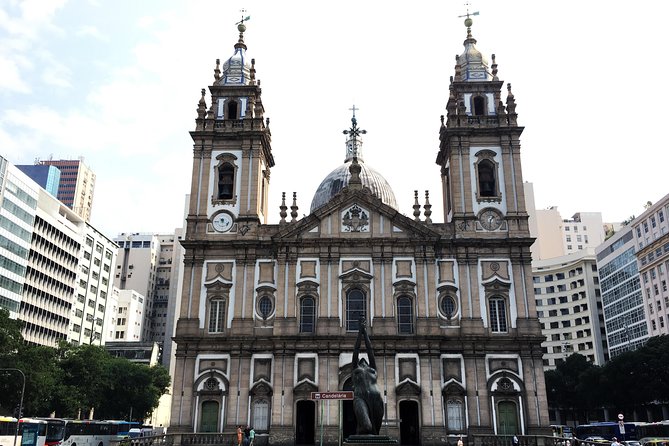
Your first stop is the Church of Our Lady of the Candelária. Construction began in 1630 and finished in 1775, which is a long stretch of history you can feel in the building’s presence. It’s listed as free to enter, so you can go inside without turning your budget into a math problem.
This is a great first stop because the church sets the tone. You’ll see the neoclassical style and get a feel for how Rio’s religious architecture developed over time. Even if you’re not the type who loves church interiors for their own sake, this one works as orientation: it helps you understand why downtown Rio became a stage for major events.
Practical tip: go in with a quick game plan—look up first, then slow down. Many people rush and miss the details that make these older interiors special.
Old downtown Rio, a few more ways to see it
São Bento Monastery: Gilt, Paint, and the Joy of Taking Your Time
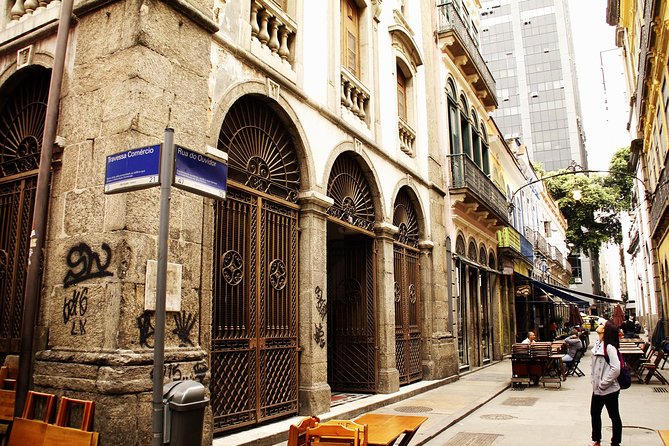
Next comes the Mosteiro de São Bento. It’s one of the most important architectural patrimony sites in Brazil, and it was founded in 1590 by two monks from Bahia. That origin detail matters. It helps explain the monastery’s place in the broader religious and cultural story of the country.
What you’ll notice inside is the contrast between stillness and visual overload. The stop is short on paper (about 10 minutes), but the payoff is huge: you get a look at paintings and gilt carvings in the interior spaces. This is one of those places where a small amount of time can still feel satisfying if your guide points out what to look for.
From what I’ve seen others describe, the monastery often becomes the “I didn’t expect this” moment. If you care about art and architecture, this is the stop worth mentally protecting. If you have only one “slow down” moment on the tour, make it this one.
Praça XV de Novembro and Paço Imperial: Where Power Got Crowned
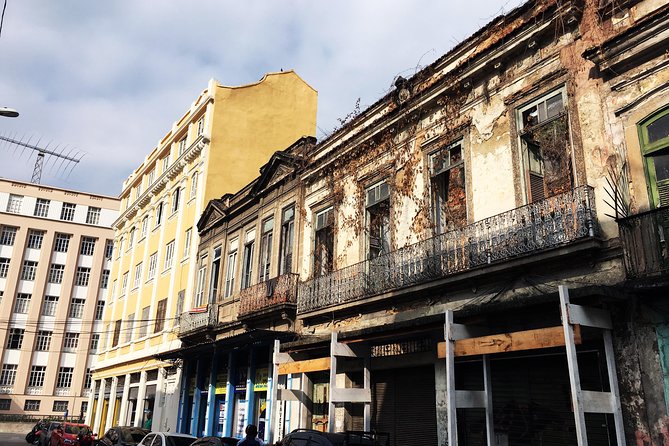
As the tour moves through central downtown, you’ll pass through Quinze de Novembro Square (also tied to Praça XV do Novembro). This is the kind of place where the stones feel political.
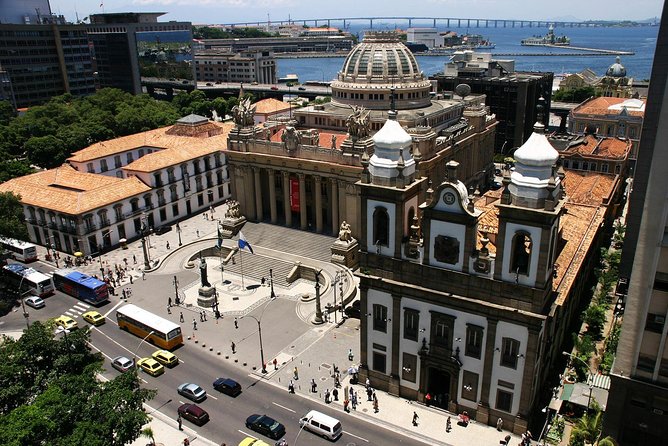
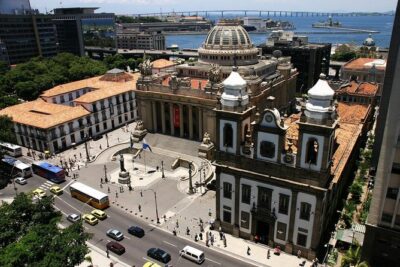
The tour focuses on events from the 1800s—when Brazil’s emperors were crowned—and it also connects the square to other major moments in Brazilian history. It’s not just a “pretty plaza.” It’s a public stage.
Then you’ll see the Paço Imperial (Imperial Palace) from the area. The palace is Portuguese-style, built in the 1700s as a home and workplace for Brazil’s rulers, and it’s also described as connected to the Portuguese Royal Family’s residence when they arrived in Brazil.
A good walking tour does more than tell dates. It explains why the buildings cluster where they do. Here, the point is simple: downtown Rio is where authority, ceremony, and governance concentrated—and you can see that pattern as you walk.
Uruguaiana Street to the Metropolitan Cathedral: A Conical Masterpiece
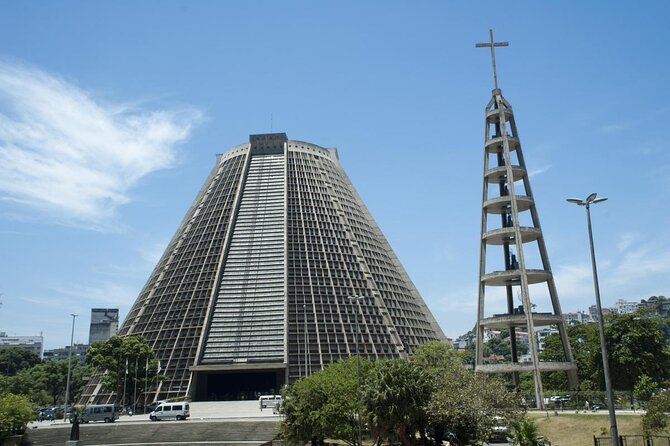
From the old squares and royal-era spaces, the route shifts toward one of Rio’s biggest modern landmarks: the Metropolitan Cathedral of Saint Sebastian.
This part of the tour is designed to give you both context and a sense of scale. The cathedral is described as an ancient conical structure, with a 96-meter internal diameter, 106-meter external diameter, and 75-meter overall height. Even if you don’t memorize the numbers, you’ll feel them when you stand back and look up.
It’s also listed as free to enter, so you can spend a little time absorbing it rather than rushing for a paid ticket. This stop tends to work well for first-time Rio visitors because it shows a different side of the city’s architecture—less colonial church glow, more civic monument.
Practical tip: take a few minutes for photos, then give yourself one slow minute just standing there. The scale hits harder when you’re not running between shots.
Mauá Square and the Olympic Legacy: Rio’s New Cultural Coastline
Then the tour turns toward the waterfront transformation: Mauá Square. This is described as a gift from the Olympic legacy that changed life for the Cariocas by creating a new pole of entertainment and culture.
Here’s what you should look for:
- the square’s role as a cultural crossroads
- two museums associated with the area: the Rio Art Museum and the Museum of Tomorrow
- the Cobra murals, which have become a recognizable visual element
The tour includes time around the area and also specifically calls out seeing the Museum of Tomorrow. If you’re lucky, you may even get a quick transport ride around the museum zone when the guide can arrange it. That can help you see more without turning this portion into a long detour on foot.
This stop is valuable for one reason: it gives you the “Rio after the Olympics” angle without making you book separate transport. It’s a practical way to connect modern Rio’s cultural projects to the larger city story you’ve been learning since the churches.
Confeitaria Colombo: A Classic Stop That’s Also a Reality Check
Next is Confeitaria Colombo, a famous bakery in downtown Rio. It’s listed as free to visit, and it’s a smart break in the tour rhythm. This is where you can take a breath and reset your energy before the last stretch.
Because food and drinks are not included, you’ll decide what you want to spend. Some people just enjoy the atmosphere and take in the space. Others buy a pastry or something light. Either way, it’s a useful pause that keeps the walking day from feeling like pure sprinting.
I also like this stop because it grounds the tour in everyday Rio. It’s not only monuments and squares. It’s a real place where people gather.
Pace, Group Size, and the $60 Value Math
The price is $60.77 per person for about 4 hours, with hotel pickup and drop-off included. For a downtown walking tour, that’s the main value lever. If you tried to recreate this yourself, you’d likely spend money on taxis or rides just getting from one cluster of sights to another—especially when traffic complicates planning.
Another value factor: several stops list free admission, including the Candelária church, São Bento Monastery, Confeitaria Colombo, and the Metropolitan Cathedral. That reduces the “hidden costs” feel you sometimes get on tours where each stop becomes a separate ticket.
There are tradeoffs, though. The tour’s not meant to be an all-day meander. You’ll cover a lot of ground, and the itinerary is designed around efficient timing. Also, because it depends on weather and it’s outdoors for portions, the day can shift if conditions change.
Group size is capped at 35, which keeps it from turning into a moving crowd. In real terms, that usually means you can hear your guide and ask questions at stops without shouting.
Safety and Comfort: How to Have a Smooth Downtown Day
Downtown Rio comes with the usual big-city reality: keep your attention on what you’re doing and avoid tuning out just because a guide is talking. One consistent theme from experiences shared by others is that guides help you stay aware of your surroundings, which can make you feel more relaxed while you’re walking through busy areas.
For comfort:
- wear shoes that handle uneven pavement and curbs
- keep your phone secured during market-street stretches
- bring a light layer if you get wind near the water later in the route
Because food isn’t included, it’s also smart to plan what you’ll do between stops. Even if you only buy a snack at Confeitaria Colombo, having a plan helps you avoid turning hunger into stress.
Who Should Book This Tour (and Who Might Want Another Plan)
This tour is a good fit if you want:
- a structured Rio de Janeiro downtown orientation on foot
- church and architecture stops that include interiors, not only exteriors
- a mix of colonial-era sites and an Olympic-era culture zone like Mauá Square
It’s less ideal if:
- you dislike walking for hours (moderate physical fitness is recommended)
- you’re hoping for a slow, flexible “wander wherever the mood hits” tour
- you’re the type who gets frustrated if traffic affects the order or amount of walking time
If it’s your first or second day in Rio, I think it works particularly well. You get a map of the city in your head, plus you learn which areas feel worth revisiting.
Should You Book This Rio City Walking Tour?
If your goal is to understand Rio’s layers—churches and royal squares on one side, Olympic-era cultural change on the other—this is a strong choice. The free-entry landmarks plus hotel pickup make it good value for a single afternoon. And if you enjoy architecture, São Bento Monastery and the Metropolitan Cathedral are the kind of stops you’ll remember after you’ve left downtown.
Book it if you:
- want a guide-led route through key downtown clusters
- like asking questions and learning what you’re looking at
- prefer not to coordinate multiple rides yourself
Skip it or swap to a different style of tour if you:
- only want long, uninterrupted walking (some time may go to transfers)
- have limited mobility and need more pacing control
FAQ
How long is the Rio city walking tour?
It runs for about 4 hours.
What’s included in the price?
You get the walking tour plus hotel pickup and drop-off to most hotels in São Conrado, Leblon, Ipanema, and Copacabana.
Are there stops with free admission?
Yes. The itinerary lists free admission for the Church of Our Lady of the Candelária, Mosteiro de São Bento, Confeitaria Colombo, and the Metropolitan Cathedral of Saint Sebastian.
Do I need to budget for food during the tour?
Food and drinks are not included.
What time does the tour start?
The start time is 1:00 pm.
Is the tour physically demanding?
The tour is listed as requiring moderate physical fitness.
What happens if weather is poor or the minimum number of travelers isn’t met?
The experience requires good weather. If it’s canceled due to weather, you’ll be offered a different date or a full refund. If it’s canceled because the minimum isn’t met, you’ll also be offered a different date/experience or a full refund.
If you’d like, tell me your hotel neighborhood and what you most care about (church interiors, imperial-era plazas, or Olympic-era culture), and I’ll suggest the best day/time to schedule this tour in your Rio plan.
More Tour Reviews in Rio de Janeiro






More of Historic Downtown Rio






More Rio City Sightseeing




Fresh off the review desk: newer Rio de Janeiro tours we have been out on





Historic & Downtown Rio, compared.
 ★ 4.4Historic Rio and Santa Teresa Half-Day TourFrom $47228 reviews
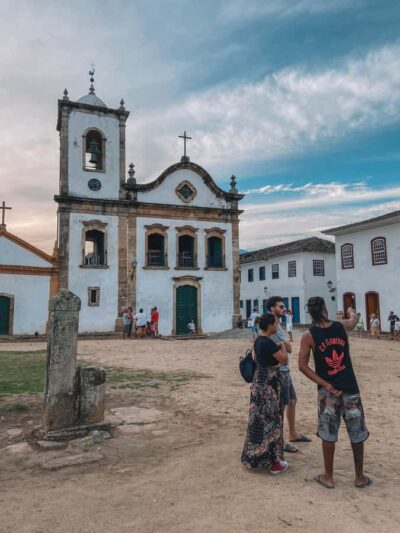 ★ 4.8Paraty: Historic Centre Walking Tour & Cachaça TastingFrom $1996 reviews
 ★ 5.0Learn the History of Rio with an Unforgettable City Center Walking TourFrom $4982 reviews
 ★ 4.5Olympic Boulevard, Museum of Tomorrow & Historical RioFrom $7266 reviews
 ★ 4.5Olympic Boulevard, AquaRio and Museum of Tomorrow TourFrom $4954 reviews
 ★ 4.5Aqua Rio + Olympic Boulevard Tour – Rio de Janeiro by Pepe Rio ToursFrom $4554 reviews
 ★ 5.0Private walk tour of Paraty’s historical center – BY PARATY TOURSFrom $8049 reviews
 ★ 4.1Olympic Boulevard, Museum of Tomorrow & History TourFrom $6747 reviews
Browse the lists this tour appears in