
Reviewed · HISTORIC & DOWNTOWN RIO
Museum of Tomorrow Guided Tour, Admission & Transfer
A futuristic museum day in Rio is a smart change of pace. You’ll spend the morning-to-afternoon at Museu do Amanhã, inside Santiago Calatrava’s spaceship-like building, with guided context and transportation built in.
I love how this tour turns sustainability into something you can actually process, linking science, art, technology, culture, and the environment into one story. I also like the add-on stops that broaden the picture beyond the museum, including Guanabara Bay viewpoints and street art around the Olympic Boulevard.
One possible consideration: the pace is efficient, and the experience depends on good weather, so you’ll want to stay flexible if rain affects timing.
In This Review
- Key Things to Know Before You Go
- What You’re Paying for at the Museum of Tomorrow
- From Copacabana to Porto Maravilha: The Transfer That Saves Your Day
- Museu do Amanhã: Interactive Futures and a Guided Point of View
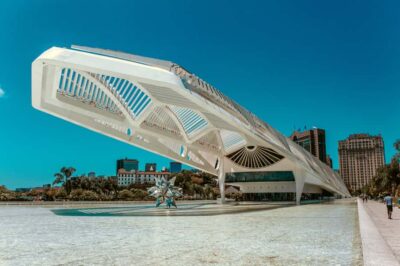
- Santiago Calatrava’s Building: The Architecture Is Part of the Lesson
- How to Use Your Museum Time (Without Rushing the Future)
- Mauá Square: Guanabara Bay and the Visionary Behind the Name
- Boulevard Olímpico: From Olympic Stage to Street-Art Wall
- Guide Quality: Jaqueline, Renato, Marcos, and Christian (and What to Expect)
- Price vs. Value: Is $58 a Fair Deal?
- Practical Tips for a Smooth Museum-and-City Day
- Who This Tour Fits Best
- Should You Book This Museum of Tomorrow Guided Tour?
- FAQ
- How long is the Museum of Tomorrow guided tour?
- What is included in the $58 price?
- Where is the meeting point, and do we return there?
- Is food included?
- Can I request pickup outside Copacabana?
- How big is the group?
Key Things to Know Before You Go
- Calatrava’s architecture first: you get more than exhibits; you get the building as part of the experience
- A guided, not-a-lecture style: strong guides are praised for clear explanations and good organization
- Porto Maravilha context: the museum sits in a regeneration zone, so you see Rio in “in progress” mode
- Photo-friendly stops: Mauá Square gives you Guanabara Bay views, and the Olympic Boulevard is a visual detour
- Small-group transport: up to 19 people per minivan helps keep the day feeling human
- Museum time that’s long enough: the main stop is set at about 3 hours, not a quick walk-through
Old downtown Rio, a few more ways to see it
- Rio de Janeiro: Historic Rio and Santa Teresa Half-Day Tour★ 4.4 · 228 reviews
- Learn the History of Rio with an Unforgettable City Center Walking Tour★ 5.0 · 82 reviews
- Rio’s city walking tour: a glimpse of history and olympic legacy★ 4.5 · 78 reviews
- Aqua Rio + Olympic Boulevard Tour – Rio de Janeiro by Pepe Rio Tours★ 4.5 · 54 reviews
What You’re Paying for at the Museum of Tomorrow
The headline price is $58 per person for a roughly 4-hour tour. The value comes from what’s included: admission to Museu do Amanhã plus air-conditioned transportation. That combination matters in Rio, where travel time can eat your day if you’re trying to do it all on your own.
This tour also bundles the museum with two extra stops that are free. That’s a big deal because the “museum-only” option would leave you with a lot of time in one place. Here, you’re looking at Rio through two lenses: the future-focused museum and the city neighborhood that’s actively reshaping itself around it.
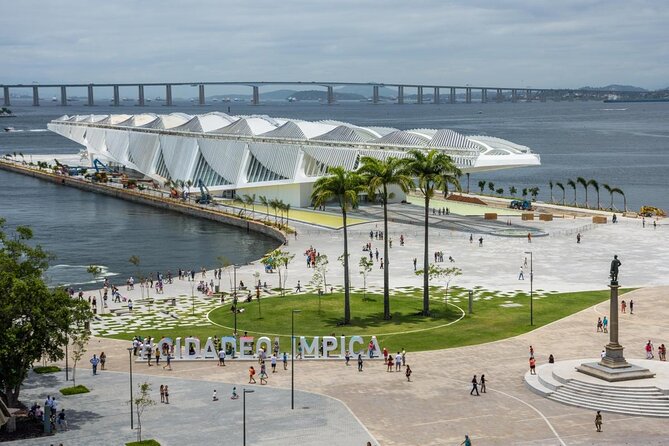
And yes, the museum is famous for its design. Santiago Calatrava’s structure has that futuristic, spaceship feel from the outside, but the tour helps you connect that design to what you’re seeing inside: how people think, act, and make choices that affect the planet.
From Copacabana to Porto Maravilha: The Transfer That Saves Your Day
You meet at Hotel Rio Othon Palace in Copacabana (Av. Atlântica, 3264). The tour ends back at the same meeting point, so you avoid the “where do I go now?” problem that can happen after a museum visit.
Transportation is in an air-conditioned vehicle, and the tour runs with a group size that keeps things comfortable: maximum 19 travelers per minivan. There’s also a larger cap for the overall activity (up to 99), but the practical takeaway for you is that you’re not stuck in a huge herd for the ride.
If you’re staying in Barra or Recreio, there’s an extra USD 10 per person pickup fee paid directly to the guide. If that’s you, factor it into your budget and do your email check, because you’ll be contacted to confirm the pickup time based on your hotel.
Museu do Amanhã: Interactive Futures and a Guided Point of View
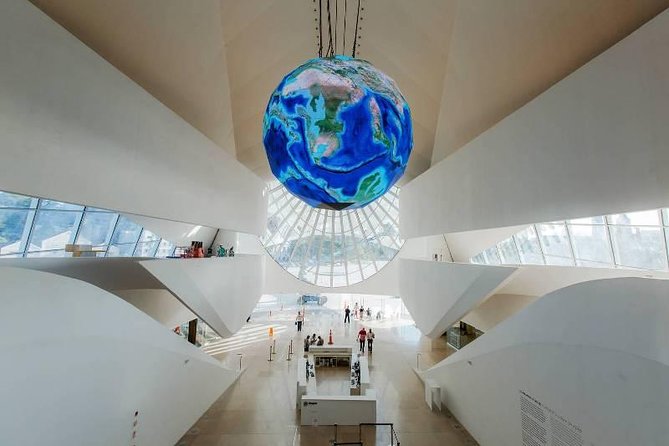
The heart of the day is the Museum of Tomorrow, a place built to make future thinking feel concrete. Your guided portion focuses on what the museum is doing conceptually: showing possibilities for human life and a sustainable future through interactive exhibits.
What I like about the way the content is structured is that it’s not trapped in one discipline. The museum connects science, art, technology, culture, and the environment, and it keeps coming back to a simple question: what will happen if humans keep making decisions the same way?
Inside, you’ll see exhibits designed to make you think about risks facing the planet—oceanic, political, and environmental. Some displays even present ideas with comparisons and numbers tied to current conditions, which helps you move from “scary idea” to “understanding what changes.”
The guided format also helps you avoid the usual museum problem: you stare at cool screens and leave thinking you missed the point. Here, the guide’s role is to tie the interactions together so your visit feels like one coherent experience, not separate stations.
Why 3 hours matters: that’s enough time to actually interact, not just glance.
Still browsing Rio de Janeiro? These are the ones we go back to


Santiago Calatrava’s Building: The Architecture Is Part of the Lesson
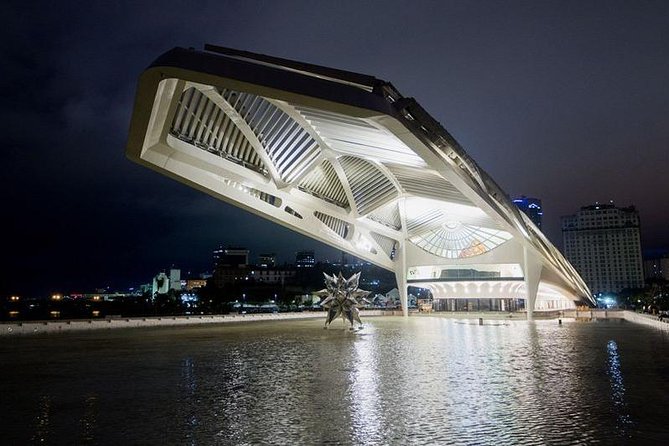
Even before you get deep into the exhibits, take in the setting. The museum is in that famous spaceship-like building designed by Santiago Calatrava. The tour is a nice reminder that architecture can act like a “prologue” to the themes you’ll meet inside.
From the outside, you can often get views of the harbor area nearby. In practice, this means your visit doesn’t have to end at the entry doors. You can get a sense of where the museum sits in the Porto Maravilha regeneration project, and you get that feeling that Rio is changing its shape around this new cultural anchor.
The museum experience also benefits from being visually planned. The exhibits are designed with crowd flow in mind, which you’ll notice if the museum is busy. That makes the guided pace work better, since you’re not constantly bumping into the back of someone else’s photo spree.
How to Use Your Museum Time (Without Rushing the Future)
The museum stop is about 3 hours, but how you spend it is up to your curiosity. If you like trying things yourself, you’ll probably use the time efficiently: interactive components naturally slow you down.
If you’re more of a reader, you’ll also do well here, because the exhibits aim to explain ideas in multiple ways rather than forcing everything into one format. Some parts may feel fast, but your best strategy is to choose a few exhibits and commit to them, then use the rest of the time to fill gaps.
Here’s what you should aim for:
- Start with the museum themes: listen to the guide’s framing so you understand what the interactions are trying to say.
- Choose your “anchor” experiences: pick 2–3 interactive exhibits that genuinely catch your attention.
- Don’t ignore the exterior: if you want context, give yourself a short window outside to get the harbor views and the neighborhood feel.
You’ll also appreciate the way the tour’s structure gives you a break between big thinking and lighter city moments. After the museum, the day gets simpler: viewpoints, then street art.
Mauá Square: Guanabara Bay and the Visionary Behind the Name
The next stop is Mauá Square, a short 30-minute break that’s all about views and quick history. From here, you can admire Guanabara Bay, which is always worth it in Rio. If you’ve been focusing on museum content for a while, this pause is like resetting your senses.
You’ll also see the statue of Barão de Mauá. The guide’s role is helpful here because it’s not just a photo stop. The statue comes with context about the visionary associated with the square’s name, which gives you a small “Rio connections” moment that complements the museum’s future-thinking themes.
Practical note: keep your camera ready, but don’t turn this into a sprint. The 30 minutes are short, so decide what matters most: wide bay photos, statue photos, or just a calm lookout while you catch your breath.
Boulevard Olímpico: From Olympic Stage to Street-Art Wall
Your final main detour is Boulevard Olímpico, created for the 2016 Olympic Games. Today, it has attracted graffiti artists, and the result is a seriously photogenic stretch of street art.
The headline work mentioned on this route is the mural Mural das Etnias by Kobra. You’ll have about 30 minutes here, which is enough time to walk, look closely, and get photos without burning your whole afternoon.
What makes this stop feel meaningful is the contrast. In the museum, you’re seeing how technology and culture connect to the future of humanity. Here, you see culture showing up in public space, layered onto a place originally built for global spectacle. It’s still “future thinking,” just in a street-level way.
Guide Quality: Jaqueline, Renato, Marcos, and Christian (and What to Expect)
This is one of those tours where the guide can make or break the experience. The best part is how often strong guiding shows up in the feedback you’re likely to see for this tour: people praise guides for being organized, for explaining context clearly, and for making the museum time feel purposeful.
Specific names that show up positively include:
- Jaqueline, praised for turning the visit into an immersive experience and tailoring the day to interests
- Renato, noted for being organized and delivering history and information clearly
- Marcos, praised for guiding through exhibits and accommodating mobility needs
- Christian, praised for making the visit enjoyable and for helping during the experience, including taking photos
Language can vary, though. One concern that shows up in the mix is that not every guide may match your exact language comfort level. If language precision matters to you, it’s worth being direct when you confirm your pickup and stating what you prefer (for example, more history vs. more interpretation).
If you have mobility needs, take heart: at least some guides have demonstrated flexibility. When you’re contacted for pickup time, mention your needs early so the guide can plan how you’ll move through the museum.
Price vs. Value: Is $58 a Fair Deal?
At $58, you’re paying for a packaged experience, not just a museum ticket. Since transportation and museum admission are included, you’re not left to figure out getting there and buying entry separately.
Then you get two additional city moments for free: Mauá Square and Boulevard Olímpico. Those stops aren’t as long as the museum, but they add variety. For most people, that variety is where the money feels justified—you’re not spending your whole day in one building, even though the museum is the star.
Food isn’t included, so plan to handle that on your own. If you’re the type who forgets meals while sightseeing (you know who you are), grab a snack before you go or plan a post-tour bite near Copacabana.
Practical Tips for a Smooth Museum-and-City Day
A few things will make your day run smoother:
- Wear comfortable shoes. You’ll be walking through museum spaces and moving between stops.
- Dress for Rio weather. It’s stated that the experience requires good weather, so if conditions aren’t ideal, expect the day to be adjusted.
- Bring a plan for water and snacks. Since food and drinks aren’t included, you’ll want your own option.
- Check your email and phone. Pickup time gets confirmed after booking, and the tour operator contacts you for the correct pickup schedule.
- Have ID handy if asked. If requested, you’ll need a copy of your ID.
- Know where you’re meeting. It’s at Hotel Rio Othon Palace in Copacabana, and you return there at the end.
One more tip: keep your phone storage ready. Between Guanabara Bay photos and the Olympic Boulevard street art, you’ll probably want more than a quick snapshot.
Who This Tour Fits Best
This tour is a strong match if you:
- Want a guided museum visit where the exhibits are connected by theme, not just displayed
- Like science and technology but also care about culture and design
- Are visiting Rio for the first time and want to see more than the usual highlights
- Enjoy neighborhood storytelling, since Porto Maravilha is part of the context
It may be less ideal if you:
- Want total freedom to roam slowly for hours without a timed structure
- Are only interested in one quick museum check-in
- Need a specific language level for every stop, because guide language can vary
That said, with the main museum portion set at about 3 hours, you should still have enough time to take in what matters to you.
Should You Book This Museum of Tomorrow Guided Tour?
If you’re the kind of traveler who likes your sightseeing to mean something, I think this is a good bet. The museum itself is the draw, but the value is in how the day is packaged: guided interpretation, included admission, and two extra city stops that balance big ideas with real Rio views.
Book it if you want a smart, efficient way to experience a modern, future-focused museum while also seeing Rio’s energy in Porto Maravilha and getting those Guanabara Bay and street-art moments. Just go in with a bit of flexibility for weather and timing, and you’ll get a day that feels both fun and thoughtful.
FAQ
How long is the Museum of Tomorrow guided tour?
The tour runs for about 4 hours (approximately), with the museum stop scheduled for 3 hours.
What is included in the $58 price?
The price includes admission to the Museum of Tomorrow and transportation in an air-conditioned vehicle.
Where is the meeting point, and do we return there?
The meeting point is Hotel Rio Othon Palace in Copacabana, and the tour ends back at the same meeting point.
Is food included?
No. Food and drinks are not included, so you’ll need to plan your own meals or snacks.
Can I request pickup outside Copacabana?
Pickup is available with an additional fee for Barra/Recreio. If you’re in Barra or Recreio, there is an extra USD 10 per person paid directly at the time of the tour.
How big is the group?
The tour has a maximum of 19 travelers per minivan, and it’s described as having a maximum of 99 travelers overall.
More Museums in Rio de Janeiro






More Tour Reviews in Rio de Janeiro






More of Historic Downtown Rio




Fresh off the review desk: newer Rio de Janeiro tours we have been out on





Historic & Downtown Rio, compared.
 ★ 4.4Historic Rio and Santa Teresa Half-Day TourFrom $47228 reviews
 ★ 4.8Paraty: Historic Centre Walking Tour & Cachaça TastingFrom $1996 reviews
 ★ 5.0Learn the History of Rio with an Unforgettable City Center Walking TourFrom $4982 reviews
 ★ 4.5Rio’s city walking tour: a glimpse of history and olympic legacyFrom $6078 reviews
 ★ 4.5Olympic Boulevard, Museum of Tomorrow & Historical RioFrom $7266 reviews
 ★ 4.5Olympic Boulevard, AquaRio and Museum of Tomorrow TourFrom $4954 reviews
 ★ 4.5Aqua Rio + Olympic Boulevard Tour – Rio de Janeiro by Pepe Rio ToursFrom $4554 reviews
 ★ 5.0Private walk tour of Paraty’s historical center – BY PARATY TOURSFrom $8049 reviews
Browse the lists this tour appears in