
Reviewed · SANTA TERESA & LAPA
Centro Historico and Lapa – Santa Teresa Walking, Historical and Bohemian Tour
If you like your Rio in layers, this is a smart way to see it. You move from grand Centro landmarks to Lapa’s street art, then climb into Santa Teresa for viewpoints and the famous yellow tram. What I really liked: the tight stop-by-stop storytelling and the mix of major sights with a few local-feeling corners. One thing to keep in mind: it’s a full day with lots of walking and some uphill sections, so comfy shoes matter.
The small group size also helps you hear everything and keep the pace human. And yes, there’s a fun drink break built in during the tour, which takes the edge off the long circuit. The day is led by experienced local guides like Ivan from Centro Historico, the kind of person who can connect architecture, politics, and neighborhood vibe without turning it into a lecture.
In This Review
- Key highlights you’ll actually care about
- A day that stitches Centro, Lapa, and Santa Teresa into one story
- Starting in Copacabana at 9:00 am, ending right back where you began
- Cinelândia: start with Rio’s “showcase” square
- The Metropolitan Cathedral of Saint Sebastian: stained glass that does the talking
- Largo da Carioca and the church-terrace moment
- Confeitaria Colombo: a short pause in old-Rio café culture
- Praça Quinze de Novembro: Republic-era landmarks and the waterfront gateway
- Praça Pio X: churches plus cultural institutions
- Mosteiro de São Bento: when a monastery is more than a building
- Mauá Square and the Museum of Tomorrow panorama (without the museum visit)
- Estúdio Kobra’s Etnias mural: Olympic-era art at street height
- The yellow bonde tram: the Santa Teresa climb you don’t want to rush
- Largo dos Guimarães: neighborhood life, not just viewpoints
- Centro Cultural Municipal Parque das Ruínas: Laurinda Santos Lobo’s view
- Escadaria Selarón: the multicolor staircase with a long personal project behind it
- Arcos da Lapa: the aqueduct arches and the graffiti story
- Price and value: what $137.80 buys you on this route
- Pace, walking, and who this fits
- What to bring so the day stays fun
- Should you book this Centro, Lapa, and Santa Teresa walking tour?
- FAQ
- How long is the Centro Historico and Lapa – Santa Teresa walking tour?
- What time does the tour start, and where do I meet?
- How many people are in a group?
- Is lunch included?
- Are any admission tickets included or free?
- What’s included for food and drinks during the tour?
- Do you visit the Museum of Tomorrow?
- Which major Santa Teresa experience is included?
- Where does the tour end?
- Is the tour suitable for most people?
Key highlights you’ll actually care about
- Centro architecture first: Cinelândia and the Metropolitan Cathedral set the tone fast.
- Largo da Carioca views: church neighbors that share a great terrace panorama.
- Lapa’s two stars: Escadaria Selarón and Arcos da Lapa, both made for photos.
- Santa Teresa by bonde: the yellow tram ride is part transport, part scenery.
- Art in the route: the Estúdio Kobra mural adds color and Olympic-era context.
- Refuel without dragging: included soda, beer, or even a caipirinha helps keep energy up.
More of bohemian Santa Teresa and Lapa
- Rio: Christ the Redeemer, Sugarloaf, Selaron & BBQ Lunch★ 4.5 · 2,428 reviews
- Rio: Pub Crawl in Lapa with Cachaça Tasting and Live Samba★ 4.7 · 881 reviews
- Rio de Janeiro: Christ, Selaron Steps, and Tijuca Park Tour★ 4.7 · 857 reviews
- Santa Teresa, Lapa, and Cinelândia with Tram Ride and Selarón Steps★ 4.5 · 274 reviews
A day that stitches Centro, Lapa, and Santa Teresa into one story
This tour works because it follows how Rio actually feels on foot: big civic spaces, then older religious streets, then street-level art, and finally hilltop charm. You start in the Centro and gradually shift your perspective, from wide squares to narrow sidewalks and staircases.
The Centro part isn’t just “look at buildings.” You get the why behind them: what was built for, what changed over time, and how the city’s identity shows up in stone, stained glass, and street plans. Then Lapa and Santa Teresa turn that same thread into lived-in neighborhoods—graffiti, balconies, viewpoints, and the tram that crawls up the hill like Rio’s own moving postcard.
Starting in Copacabana at 9:00 am, ending right back where you began
Convenience matters on a long walking day. You meet at Copacabana Palace (a Belmond Hotel) at 9:00 am. The tour ends back at the meeting point, which makes planning dinner later much easier.
This is also a good sign of how the route is designed: you’re not spending your day figuring out transit between distant areas. You’re getting a guided path from the Centro core to Lapa and up to Santa Teresa, and the finish stays simple.
Group size is capped at 12, which is huge for quality. Smaller groups mean fewer bottlenecks at viewpoints and less time waiting for everyone to regroup.
Cinelândia: start with Rio’s “showcase” square
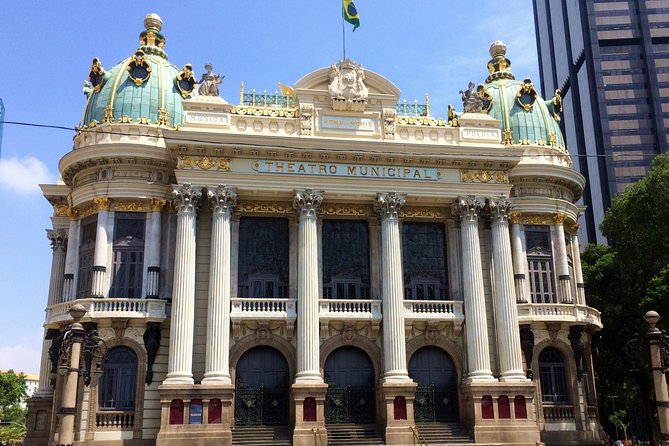
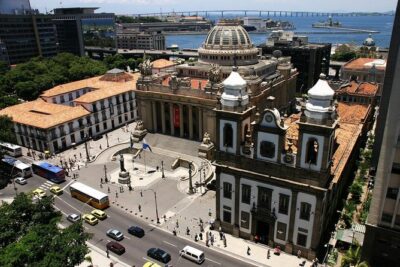
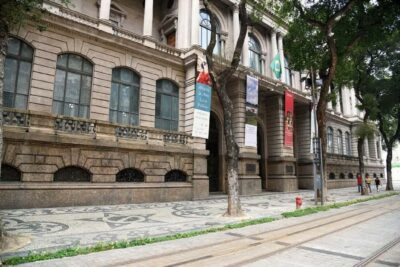
You begin at Cinelândia, a square that feels like Rio planned it for pageantry. Here you get a fast orientation to major landmarks around the square, including the Teatro Municipal, the Museu de Bellas Artes, and the old-school official vibe of nearby civic buildings.
Two details make this stop extra useful. First, it gives you a mental map for the rest of the Centro—once you see how Teatro Municipal and the museum buildings anchor the square, the city’s layout makes more sense. Second, Cinelândia also includes a working theater/cinema node (the Odeon is noted as still in operation), so you can see how culture remains active, not frozen in the past.
Old downtown Rio, a few more ways to see it

The Metropolitan Cathedral of Saint Sebastian: stained glass that does the talking
Next up is the Metropolitan Cathedral of Saint Sebastian. You go inside, and the focus is the architecture and the history, plus the monumental stained glass windows.
This is one of those stops where being on a guided timeline helps. Without context, a cathedral can feel like another impressive building. With guidance, you start noticing what the design is trying to say—how scale and light make the interior feel both civic and personal at the same time.
It’s also short enough that it doesn’t slow the day down, but long enough that you can look around rather than just walk past.
Largo da Carioca and the church-terrace moment
Largo da Carioca is a classic Rio “in-between” space: not just a plaza, but a doorway into neighboring streets and churches. You pass by Sao Antonio church and Sao Francisco da Penitencia, both highlighted for their baroque beauty and their close-by terrace viewpoints.
The value here is the perspective shift. You’re walking street-level, then you get the chance to look outward from a higher angle. That matters because later on you’ll be doing more viewpoints in Santa Teresa and around Lapa—so this early terrace taste helps you appreciate what’s coming.
Confeitaria Colombo: a short pause in old-Rio café culture
You reach Confeitaria Colombo via pedestrian streets in old Rio. The point isn’t a long café meal. It’s a quick stop at an iconic, long-running café known for its art deco style.
This works well in a walking tour because it’s timed as a reset. You get a sense of how Centro people used to gather and how “old institutions” still anchor daily life. Even if you don’t order anything beyond a casual glance, you’ll leave feeling like you stepped into a real Rio interior, not just a photo location.
Praça Quinze de Novembro: Republic-era landmarks and the waterfront gateway
From there you move toward Praça Quinze de Novembro, tied to the proclamation of the Republic. You’ll see major landmarks clustered here, including the Church of Our Lady of the Carmelites, the Paço Imperial, and the Equestrian Statue of General Osorio. You also get a waterfront-focused moment with Tax Island and the ferry pier to Niteroi and Paqueta.
This stop is helpful because it connects Centro to the water. Rio isn’t just inland streets and hills. It’s a bay city, and this is one of the places where that coastal relationship becomes visible.
Praça Pio X: churches plus cultural institutions
Praça Pio X is another Centro square that keeps your eyes moving. You’re guided through the pedestrian streets to see the Candelária church, plus the Olympic Boulevard, and cultural spots like the CentrO Cultural do Banco do Brasil and casa França Brasil.
The reason I like including squares like this in a walking tour is that they show Rio in transition. You see religion, modern culture, and national identity all layered on the same axis. It helps you stop thinking of Rio as only beach and samba and start seeing it as a full civic system.
Mosteiro de São Bento: when a monastery is more than a building
Then comes Mosteiro de São Bento, one of Rio’s standout church visits. You go inside, with the guide talking through the monastery’s history and what makes this church special.
This is one of the longer “attention” stops on the day, and it pays off. Monastery spaces have a way of slowing time. The guidance helps you notice features you might otherwise miss—how religious architecture carries meaning in daily life, not just as a tourist object.
Mauá Square and the Museum of Tomorrow panorama (without the museum visit)
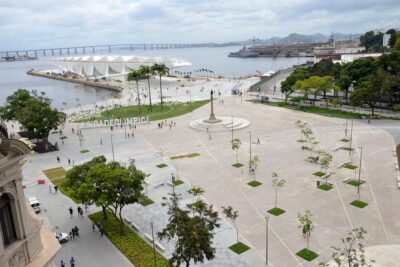
At Mauá Square, you’re in the big-city theater again—this time with a futuristic layer. The Museum of Tomorrow (Museu de Amanhã) is mentioned as architecturally interesting, and while you do not visit it, you still get a strong viewpoint setup.
You also visit the area tied to the Art Museum of Rio, with its panoramic terrace. From up there, you can view Mauá Square, the Niterói Bridge, and the bay. Even without stepping into every building, that terrace angle gives you the “Rio at scale” effect that’s hard to get from street level.
Estúdio Kobra’s Etnias mural: Olympic-era art at street height
Before you head into Santa Teresa, you stop for Etnias – Mural de Graffiti (Estúdio Kobra). This mural is described as the largest in the world, created by Eduardo Kobra for the Olympic Games and representing five ethnic groups.
This stop matters because it keeps the day from becoming only official monuments. It’s public art with a message, and it connects Rio’s current identity to international attention from the Olympics era—without making it feel like a museum exhibit.
The yellow bonde tram: the Santa Teresa climb you don’t want to rush
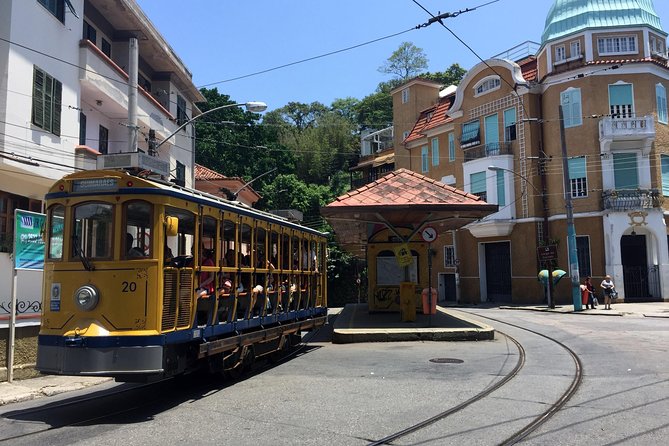
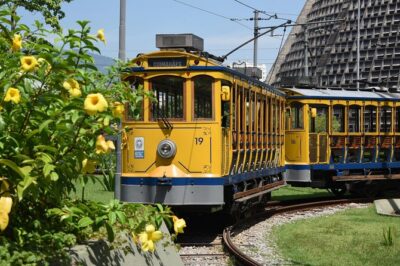
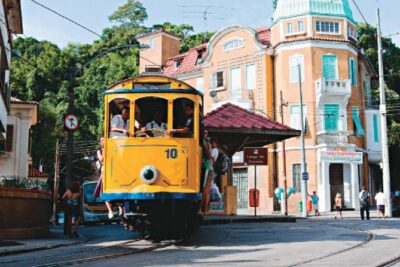
Now the day shifts. You walk back toward the Santa Teresa tram station and take the famous yellow bonde tram up to Santa Teresa. You’re on it for about 30 minutes, and it’s described as a panoramic ride full of charm.
This is a key included moment. Yes, it’s transport. But it also gives your legs a break and gives your eyes a moving viewpoint. That matters because later you’re walking around Largo dos Guimarães and reaching Santa Teresa viewpoints again.
Largo dos Guimarães: neighborhood life, not just viewpoints
In Santa Teresa, you spend time around Largo dos Guimarães, with its houses from the late 19th and early 20th centuries. You get views, plus time to take in restaurants and bars that make the neighborhood famous.
This section is where the tour feels more local. You’re not only chasing landmarks—you’re absorbing street rhythm and the way people live on hill slopes.
If you like your photos to include a little human context (balconies, street corners, café fronts), this is one of the better moments to slow down.
Centro Cultural Municipal Parque das Ruínas: Laurinda Santos Lobo’s view
One of Santa Teresa’s iconic points is Centro Cultural Municipal Parque das Ruínas, formerly associated with Laurinda Santos Lobo, now set up as a gazebo with sweeping views.
You see arches of Lapa, the Christ view, and the Botafogo direction from this elevated perspective. Even when you know Christ is out there, getting the viewpoint framing from Parque das Ruínas makes it click how Rio’s hills and neighborhoods create natural photo corridors.
Escadaria Selarón: the multicolor staircase with a long personal project behind it
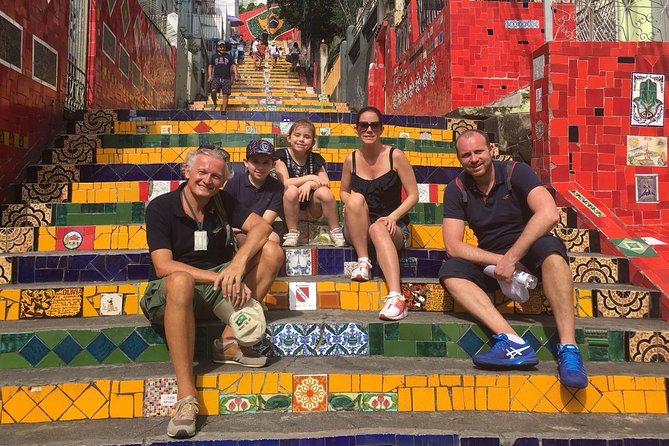
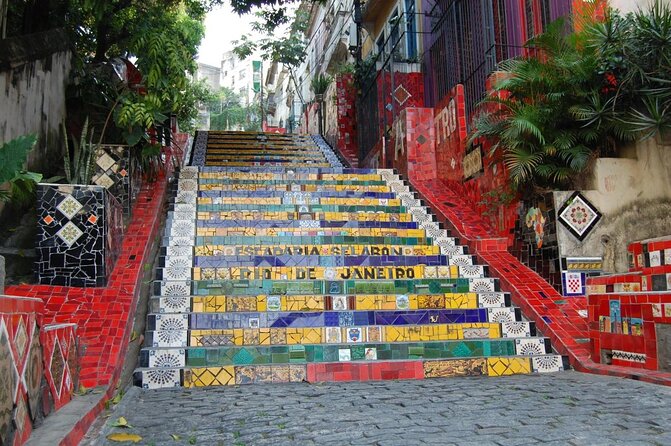
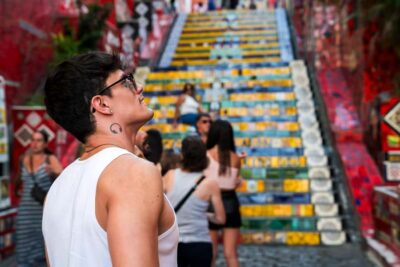
Next is Escadaria Selarón, the famous multicolored staircase created by Chilean artist George Selarón over about twenty years.
This isn’t just an Instagram wall. It’s an ongoing personal artwork that turned a hillside passage into a symbol. During this stop, you have time to take your bearings at the base and then appreciate how the staircase fills the street with color as you look up.
Arcos da Lapa: the aqueduct arches and the graffiti story
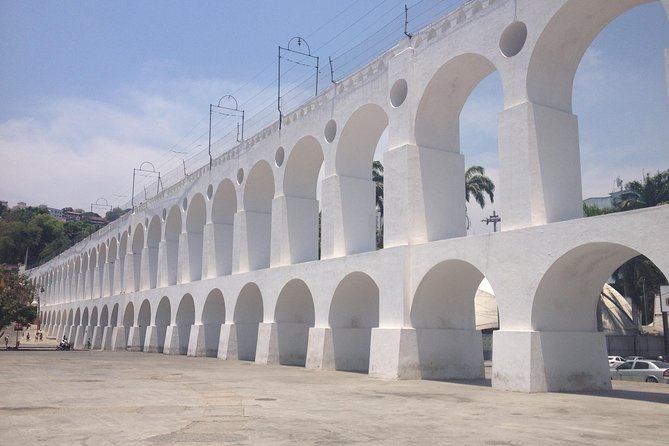
You finish by heading down toward Lapa and the Arcos da Lapa, the old Rio aqueduct dating from the 18th century that supplied water until the end of the 19th century. The area is also decorated with multiple graffiti murals, including the kind that you can watch from different angles near the arches.
The tram line also connects here back up toward Santa Teresa. That detail matters because it turns Lapa from a single photo stop into part of a bigger movement pattern: the city’s historic infrastructure and modern street culture sharing the same corridor.
Price and value: what $137.80 buys you on this route
At $137.80 per person for a 7–8 hour day, the value comes from three things you actually get, not just “a guide walks with you.”
1) Long-distance access without extra planning
You’re connecting Centro, Lapa, and Santa Teresa in one continuous flow, which saves time and helps you avoid piecing together routes on your own.
2) Most admissions are free, and key paid moments are handled
Many stops are marked as free entry, and the tram ride is included. You’re not paying separately for each sight.
3) Refreshments help you stay steady
The tour includes a drink option: caipirinha, beer, soda, fruit juice, or water. That’s a practical inclusion on a long walking day, especially if you want to keep moving rather than searching for a place to stop for food.
Lunch is not included, though. So if you’re the type who gets hungry at predictable times, plan to grab a meal on your own near the route rather than assuming the tour will handle it.
Pace, walking, and who this fits
This is listed as suitable for most people, with walking time spread across many stops. It’s not described as a strenuous hike, but the Santa Teresa portion and the staircase/lower Lapa movement do mean you should expect uneven sidewalks and some uphill effort.
This tour is a great fit if you want:
- A guided overview that makes Rio’s layout easier to understand.
- A mix of major sights plus street-level culture.
- A full-day plan that uses Santa Teresa’s tram ride instead of only stairs.
If you prefer a mostly seated, low-walking day, you might find the hours too active. But if you enjoy walking and want the city connected into one route, this works well.
What to bring so the day stays fun
You’re outdoors for much of the day and moving between hills and squares. Bring:
- Comfortable walking shoes with grip
- Sun protection (hat/sunglasses)
- Water or plan to use the included drink options to stay hydrated
- A camera, because you’ll have repeated viewpoint moments in multiple neighborhoods
Also, don’t overpack. The charm of this kind of tour is moving lightly from one spot to the next.
Should you book this Centro, Lapa, and Santa Teresa walking tour?
Book it if you want a one-day Rio highlights route that still feels grounded: cathedral interiors, major Centro squares, Lapa’s artsy edges, and Santa Teresa’s hilltop viewpoints with the iconic yellow bonde tram ride.
Skip it if you want minimal walking or if you’re hoping for a lunch included plan. Also, if you care about entering every single major museum building, note that the Museum of Tomorrow is not visited here, even though the views and architecture are part of the day.
FAQ
How long is the Centro Historico and Lapa – Santa Teresa walking tour?
The tour lasts about 7 to 8 hours.
What time does the tour start, and where do I meet?
It starts at 9:00 am at Copacabana Palace, A Belmond Hotel, Rio de Janeiro.
How many people are in a group?
The maximum group size is 12 travelers.
Is lunch included?
No. Lunch is not included.
Are any admission tickets included or free?
Many stops are free, and the Largo da Carioca stop includes an admission ticket. The tram ride to Santa Teresa is also included.
What’s included for food and drinks during the tour?
You’re offered a caipirinha, a beer, a soda, a fruit juice, or water during the tour.
Do you visit the Museum of Tomorrow?
No. The Museum of Tomorrow is mentioned for its architecture, but it is not visited.
Which major Santa Teresa experience is included?
The tour includes a ride on the yellow Santa Teresa bonde tram from the station up to Santa Teresa.
Where does the tour end?
It ends back at the meeting point.
Is the tour suitable for most people?
The information states that most travelers can participate.
More Tour Reviews in Rio de Janeiro






More of Historic Downtown Rio






Santa Teresa and Lapa, Three More Ways




Fresh off the review desk: newer Rio de Janeiro tours we have been out on





Santa Teresa & Lapa, compared.
 ★ 4.5Christ the Redeemer, Sugarloaf, Selaron & BBQ LunchFrom $692,428 reviews
 ★ 4.7Pub Crawl in Lapa with Cachaça Tasting and Live SambaFrom $33881 reviews
 ★ 4.7Christ, Selaron Steps, and Tijuca Park TourFrom $68857 reviews
 ★ 4.5Santa Teresa, Lapa, and Cinelândia with Tram Ride and Selarón StepsFrom $60274 reviews
 ★ 4.4Historic Rio and Santa Teresa Half-Day TourFrom $47228 reviews
 ★ 4.3Corcovado, Sugarloaf Mountain, and Selarón Steps 6-Hour TourFrom $146167 reviews
 ★ 4.5Ancient Rio and Santa Teresa Tour with Hotel pick-up and drop-offFrom $55154 reviews
 ★ 4.3Christ the Redeemer & Selarón Steps Half-Day TourFrom $58136 reviews
Browse the lists this tour appears in